Long hours at a desk can leave your shoulders feeling heavy, your neck stiff and your upper back uncomfortable. You may notice the tension building gradually during the working day, especially after concentrating on a laptop, attending online meetings or repeatedly using a mouse. By the evening, even turning your head or relaxing your shoulders can feel more difficult than it should.
This is a familiar experience for many office workers in Edinburgh. The good news is that small changes to your working habits, regular movement and appropriate massage treatment can often help you manage muscular tension and feel more comfortable.
Why can desk work affect the neck and shoulders?
The body is designed to move, but desk work often keeps it in one position for extended periods. The UK Health and Safety Executive (HSE) explains that incorrect use of display screen equipment or a poorly arranged workstation may contribute to pain in the neck, shoulders, back, arms, wrists and hands.
Several factors may contribute to discomfort:
- Sitting in the same position for too long
- Leaning forwards towards a laptop or monitor
- Holding the shoulders raised while typing
- Reaching repeatedly for a mouse
- Using a screen that is too low or too far away
- Working from a sofa, bed or unsuitable chair
- Stress, which may cause you to tense your shoulders without noticing
There is no single “perfect” posture that must be maintained all day. Even a well-supported position can become uncomfortable when it is held for too long. Changing position regularly is just as important as arranging your workstation properly.
Common signs of desk-related muscular tension
People who spend much of their day at a computer may experience:
- Tightness across the tops of the shoulders
- An aching or stiff neck
- Discomfort between the shoulder blades
- Reduced comfort when turning the head
- Tension-type headaches
- A tired or heavy feeling in the upper back
- Tender areas within the upper trapezius and surrounding muscles
These symptoms can have many possible causes, so they should not automatically be blamed on posture or desk work. A massage therapist can assess muscular tension and movement within their professional scope, but massage is not a substitute for medical diagnosis.
How may massage help?
Massage can be used as one part of a broader approach to managing everyday muscular tightness. Treatment is adapted to the individual rather than applying the same pressure and techniques to everyone.
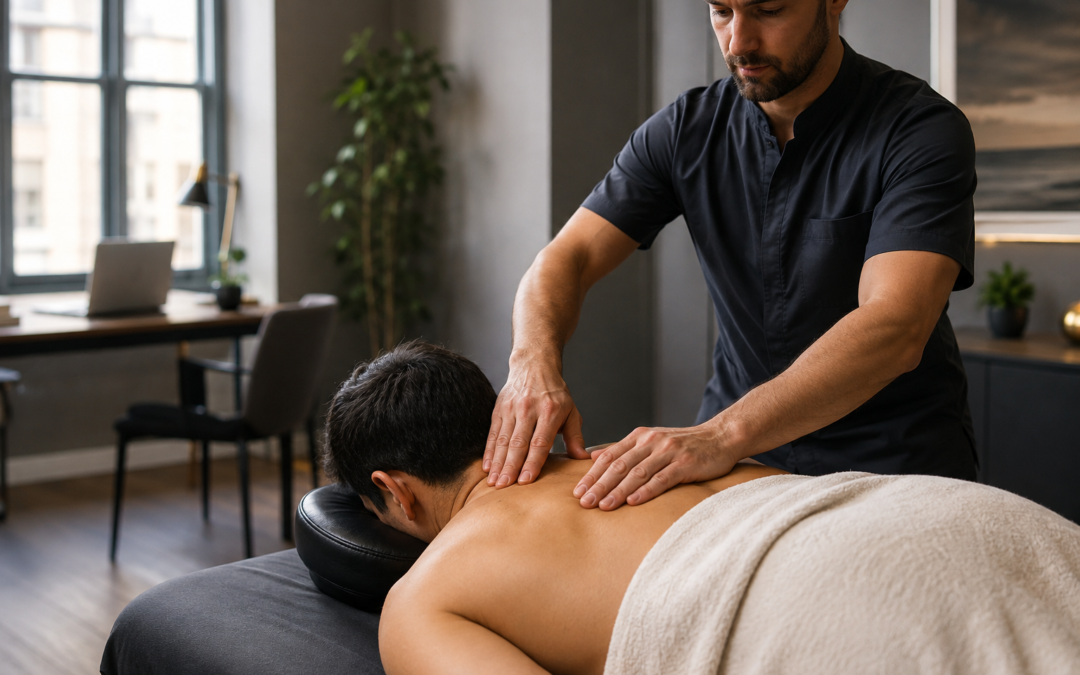
A session may focus on the neck, shoulders, upper back and muscles around the shoulder blades. Depending on your needs and preferences, the treatment may include deep-tissue techniques, targeted work on sensitive muscular areas, soft-tissue mobilisation and gentle assisted movement.
Some clients report short-term improvements in comfort, relaxation and ease of movement after massage. However, research should be presented honestly. A 2024 Cochrane review indexed by PubMed found that the contribution of massage to neck-pain management remains uncertain because much of the available evidence is low certainty. Massage should therefore be considered a supportive option—not a guaranteed cure or a replacement for appropriate healthcare.
Depending on the individual, massage may support:
- A temporary reduction in the sensation of muscular tightness
- Encouraging relaxation after a demanding working week
- Improving comfort during everyday movement
- Helping you become more aware of where you habitually hold tension
- Supporting recovery alongside movement, exercise and workstation changes
The aim is not simply to apply the strongest possible pressure. Effective treatment should be purposeful, controlled and matched to your comfort. You should always be able to communicate if the pressure needs to be adjusted.
What happens during a Hermeduss appointment?
Your appointment begins with a short consultation. You can explain where you feel discomfort, when it started, what makes it better or worse and whether it affects your work, sleep, training or daily activities. You should also disclose relevant medical conditions, injuries and medications before treatment.
The treatment can then be tailored to the areas that need attention. For an office worker, this may include the upper trapezius, muscles around the shoulder blades, upper back and chest, depending on the findings and your consent. Your comfort and privacy are maintained throughout the appointment.
After the massage, you may be given simple, appropriate advice to support the treatment. Massage should form part of a sensible plan rather than being treated as a cure for every type of neck or shoulder pain.
Five ways to feel better during your working day
1. Change position regularly
Avoid waiting until you feel very stiff. Stand up, walk briefly or gently move your shoulders at regular points throughout the day. Short, frequent changes are often easier to maintain than one long movement break.
2. Position your screen correctly
The HSE’s workstation guidance advises placing the top of the screen around eye level and approximately an arm’s length away. If you work mainly from a laptop, a separate keyboard and mouse may make it easier to raise the screen while keeping your arms comfortable.
3. Relax your shoulders
Your keyboard should be positioned so that you do not need to shrug or reach forwards. Check several times during the day whether your shoulders have gradually lifted towards your ears, then allow them to relax naturally.
4. Support your back
Adjust the chair so your back is supported and your feet are stable. Avoid forcing yourself into a rigid position. A comfortable, supported setup should still allow you to change position.
5. Keep moving outside work
Walking, general physical activity and suitable strengthening or mobility exercises can support your overall capacity. If an exercise causes pain, numbness or worsening symptoms, stop and obtain advice from an appropriate healthcare professional.
When should you seek medical advice?
Massage is not appropriate for every presentation. Contact your GP or another appropriate healthcare professional if your symptoms persist, worsen or concern you. The NHS guidance on neck pain advises seeking medical advice when neck pain or stiffness does not settle after a few weeks, pain relief has not helped, or symptoms include pins and needles or a cold arm. NHS inform also provides Scotland-specific self-care and help guidance.
Urgent assessment may be necessary after a significant injury or if symptoms include severe or rapidly worsening pain, marked weakness, loss of coordination, chest pain or other signs of serious illness. When in doubt, seek medical advice before booking a massage.
Give your shoulders a break
Desk-related tension does not have to become the normal end to every working day. Regular movement, a better-arranged workstation and individually adapted massage may help you feel more comfortable and less restricted.
If your neck and shoulders feel tight after long hours at a computer, book a sports or deep-tissue massage with Hermeduss Sports & Deep Tissue Massage in Edinburgh. Your treatment will be tailored to your needs, comfort and goals.
Book your appointment and regenerate your body.