Cupping therapy has become a familiar sight in sport and recovery. The circular marks seen on athletes’ shoulders and backs often attract attention—but what does cupping actually do, and how much of its reputation is supported by research?
At Hermeduss Sports & Deep Tissue Massage in Edinburgh, cupping can be used as a complementary technique within an individual treatment plan. It is not a miracle cure, and it should never replace an appropriate medical assessment. This article explains how cupping works, what benefits it may offer, what the current evidence says and which popular claims should be treated cautiously.
What is cupping therapy?
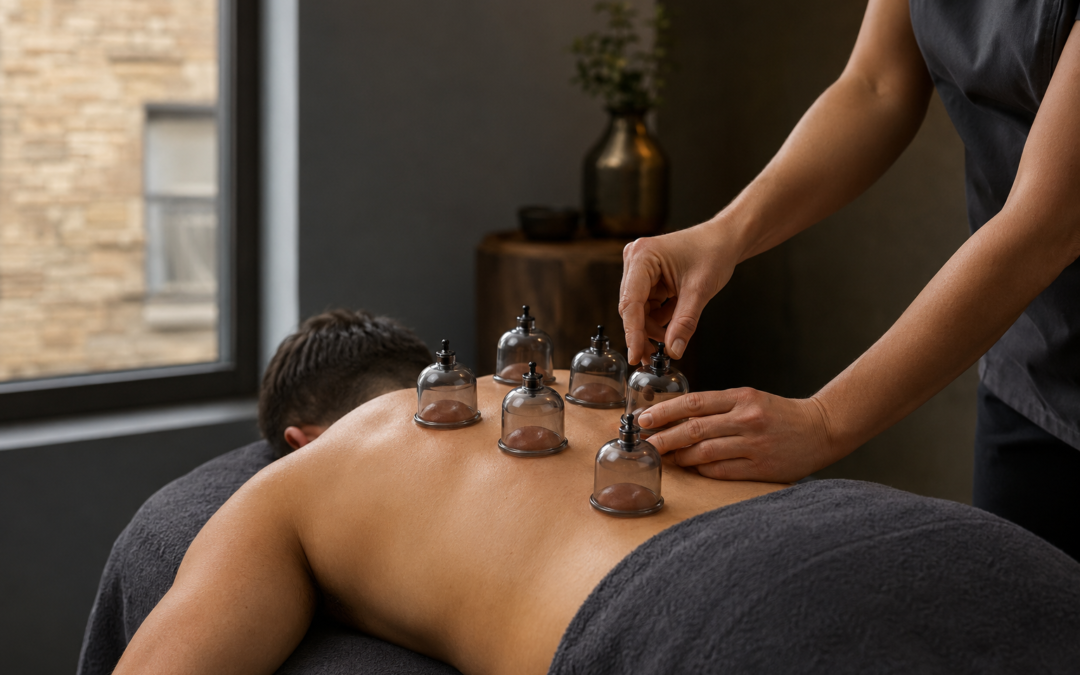
Cupping is a traditional practice used in several parts of the world. A practitioner places cups—commonly made from plastic, glass or silicone—on the skin and creates negative pressure inside them. This suction gently lifts the skin and superficial tissues into the cup.
There are several forms of cupping:
- Dry cupping: suction is applied without breaking the skin.
- Moving cupping: cups are moved across lubricated skin.
- Wet cupping: the skin is pierced so that blood enters the cup.
In a sports massage setting, dry or moving cupping is generally the relevant technique. Wet cupping is an invasive procedure with additional infection and blood-exposure risks and is not the same as routine dry cupping (NCCIH, 2018).
What may cupping help with?
People commonly choose cupping for muscular tightness, general aches, neck or back discomfort, and recovery after physical activity. The unusual pulling sensation may feel relaxing, and some clients report that an area feels easier to move afterwards.
Research suggests that cupping may reduce pain in the short term for some people. A systematic review of dry cupping for musculoskeletal pain and range of motion found favourable results for pain in conditions including chronic neck pain and non-specific lower-back pain. However, the authors also reported substantial variation between studies and noted that firm conclusions could not be made about range of motion or functional improvement (Wood et al., 2020).
A broader evidence-mapping study found possible benefits in musculoskeletal and sports rehabilitation, particularly for pain-related outcomes, but also highlighted the limited quality of much of the available evidence (Mohamed et al., 2023). Similarly, Wang et al. (2023) concluded that evidence across pain conditions ranged from very low to moderate quality. More recent research on chronic musculoskeletal pain reported an immediate reduction in pain intensity, but no clear improvement in functional disability or mental health outcomes (Jia et al., 2025).
The most accurate conclusion is therefore that cupping may be a useful complementary option for temporary symptom relief, but it is not guaranteed to work and evidence for long-term benefits remains limited.
How is cupping thought to work?
Several explanations have been proposed. Suction changes the mechanical input received by the skin and superficial tissues and may influence how pain is perceived by the nervous system. It also produces a local response in the treated area.
However, the exact biological mechanism has not been established. Claims that cupping definitely “breaks up scar tissue,” permanently lengthens muscles or mechanically pulls toxins out of the body go beyond the available evidence. A person may genuinely feel better after treatment, but that does not prove every proposed explanation for the effect.
Common cupping myths
Myth 1: Darker marks mean more toxins were removed
The marks are mainly caused by the suction’s effect on small blood vessels beneath the skin. Their colour can vary according to suction strength, treatment duration, skin characteristics and the area treated. Darker marks are not a measurement of toxins and do not show that one person “needed” cupping more than another.
Myth 2: Cupping detoxifies the body
There is no good clinical evidence that dry cupping removes toxins from the body. The liver, kidneys, lungs and digestive system already process and eliminate waste. Cupping should be described as a complementary physical therapy—not a detoxification treatment.
Myth 3: The treatment must be painful to work
Cupping creates pressure and pulling, but it does not need to be intensely painful. Stronger suction is not automatically more effective. Treatment should be adjusted to the client’s comfort, skin response and goals. Sharp pain, burning, numbness or feeling unwell should be reported immediately.
Myth 4: Cupping can cure an injury
Cupping cannot repair a torn ligament, heal a fracture or diagnose the source of unexplained pain. It may help some people manage discomfort as part of a broader plan, which could also include activity modification, graded exercise, rehabilitation or medical care.
Myth 5: The circular marks are dangerous bruises
Temporary discolouration is an expected response, but cupping is not risk-free. The National Center for Complementary and Integrative Health lists possible adverse effects including persistent discolouration, scars, burns and infections; it may also aggravate eczema or psoriasis (NCCIH, 2018). Appropriate screening, controlled suction, good hygiene and clear aftercare advice are therefore important.
Is cupping suitable for everyone?
Cupping should not be applied over broken or infected skin, active rashes, recent wounds, burns, suspected fractures or areas with unexplained swelling. Extra caution is needed if you bruise easily, have a bleeding disorder, take blood-thinning medication, have reduced skin sensation or have a health condition that affects healing.
Always tell your therapist about medical conditions, medication, pregnancy, recent surgery and current injuries before treatment. If pain is severe, follows significant trauma, is accompanied by fever or unexplained weight loss, or involves progressive weakness, numbness, bladder or bowel changes, seek medical assessment rather than booking cupping as the first response.
What should you expect after treatment?
Temporary circular marks are common and may remain visible for several days. Some people experience mild tenderness or sensitivity. Keep the area clean, avoid scratching it and contact an appropriate healthcare professional if you develop blistering, increasing pain, heat, spreading redness, discharge or other signs of infection.
Before an event, holiday or photo session, remember that the marks can be noticeable. Your therapist should explain this before obtaining your consent.
A realistic approach to cupping therapy
Cupping is best viewed as one possible tool—not a cure-all. For some clients, it may provide short-term relief, relaxation or a helpful change in sensation. For others, a different technique or an exercise-based approach may be more suitable.
At Hermeduss, treatment should always be matched to your symptoms, preferences and goals. The aim is not to create the darkest marks or use the strongest suction. It is to provide a safe, comfortable and considered treatment that supports your wider recovery plan.
If you are interested in cupping therapy in Edinburgh, contact Hermeduss Sports & Deep Tissue Massage to discuss whether it may be appropriate for you.
This article is for general information only and is not a substitute for diagnosis or treatment from a qualified healthcare professional.
References
Jia, Y., et al. (2025) ‘Effects of cupping therapy on chronic musculoskeletal pain and functional disability: A systematic review and meta-analysis’, BMJ Open, 15. Available at: https://pubmed.ncbi.nlm.nih.gov/40441767/ (Accessed: 17 August 2026).
Mohamed, A.A., et al. (2023) ‘Evidence-based and adverse-effects analyses of cupping therapy in musculoskeletal and sports rehabilitation: A systematic and evidence-based review’, Journal of Back and Musculoskeletal Rehabilitation, 36(1), pp. 3–19. Available at: https://pubmed.ncbi.nlm.nih.gov/35848010/ (Accessed: 17 August 2026).
National Center for Complementary and Integrative Health (NCCIH) (2018) ‘Cupping’. Available at: https://www.nccih.nih.gov/health/cupping (Accessed: 17 August 2026).
Wang, L., et al. (2023) ‘Efficacy of cupping therapy on pain outcomes: An evidence-mapping study’, Frontiers in Neurology, 14, 1266712. Available at: https://pubmed.ncbi.nlm.nih.gov/37965178/ (Accessed: 17 August 2026).
Wood, S., Fryer, G., Tan, L.L.F. and Cleary, C. (2020) ‘Dry cupping for musculoskeletal pain and range of motion: A systematic review and meta-analysis’, Journal of Bodywork and Movement Therapies, 24(4), pp. 503–518. Available at: https://pubmed.ncbi.nlm.nih.gov/33218554/ (Accessed: 17 August 2026).